
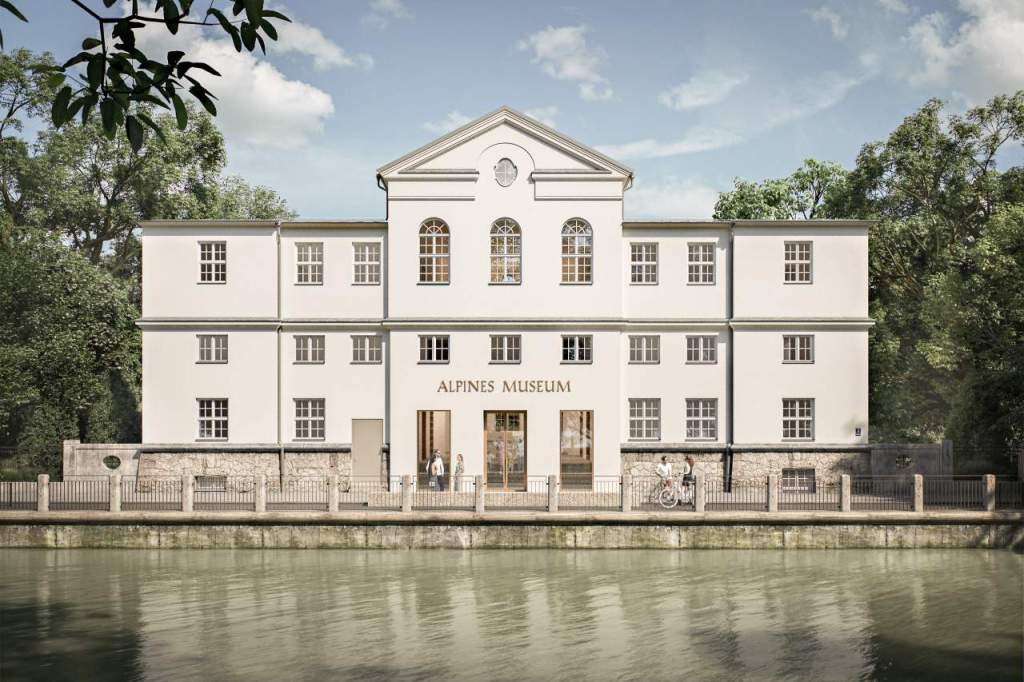
Three years ago, the Alpine Museum of the GERMAN ALPINE CLUB (DAV) closed its doors to become fit for the future with a fundamental renovation: more modern, more open, more barrier-free.
Now, mountain and mountain sports enthusiasts can enjoy larger exhibition and event areas, a common entrance foyer with a catering area, the centrally located library and the new permanent exhibition.
The rooms were completely gutted and subsequent fixtures were removed. As a result, more spacious rooms were created on the ground floor and upper floor for the newly designed permanent exhibition and the special exhibitions as well as for the library.
A continuous space, which is used as a foyer, café and event space, connects the public areas. The museum garden is currently being redesigned based on the original terraces from 1887 and will enable a smooth transition from the urban to the natural environment in the future.
“The DAV wants to become climate-neutral by 2030, so the topic of sustainability was a particular concern for us,” emphasised Stierle. Thus, the room concept and structure were kept flexible which allows for a wide variety of usage options without major structural interventions.
The former ballroom can already be used as an event venue or exhibition space as can the two adjacent exhibition rooms. In order to reduce energy consumption, the building services have been significantly reduced and designed to be very energy-efficient, especially compared to other museums.
“Our new permanent exhibition explores this special relationship in five chapters in an inclusive way and with many multimedia as well as experience and hands-on stations.”

People, images and objects tell of a thirst for adventure, body sensation, performance, experience of nature and community, of continuities and ruptures in five main themes.
“In addition, we have come up with a colorful program. Consisting of guided tours or special events such as ‘Toothed like the jaw of an alligator’, in which Ingrid Runggaldier takes us on a discovery tour of the Dolomites with the great travellers of the 19th and early 20th centuries,” added Kaiser.
“One focus of the cultural work in the DAV is the discussion and presentation of current topics. Probably the most topical and dramatic topic is climate change, which will massively affect the Alpine region from different directions and lead to major changes. That’s why we’re opening the ‘Future of the Alps’ exhibition on 4 July, which focuses on the effects of global warming.”
Anton Biebl, Cultural Officer of the City of Munich, noted, “The Alpine Museum tells about mountains and people, about the delicate balance between culture and nature. Now there are modern and barrier-free spaces on the Prater Island in Munich that deserve the topics and the audience. I am sure that the newly designed museum will be able to convey the love of nature and the fascination of the mountains even more.”
Main image credit: The new façade of the Alpine Museum. Photo: Feil Architekten, Regensburg
 Traynor On The Trail