
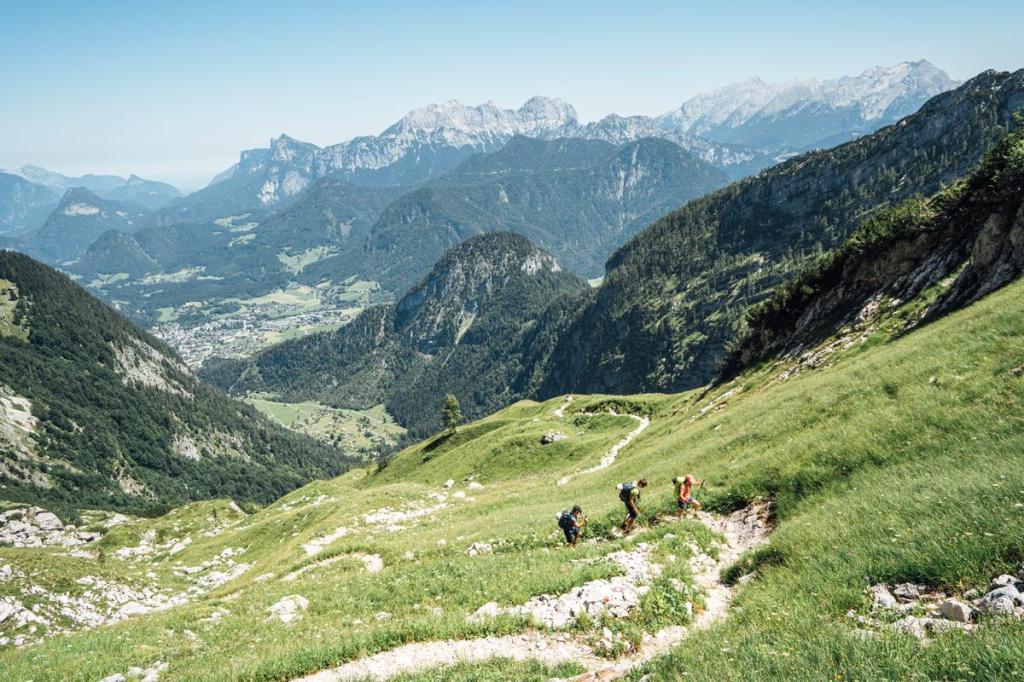
On hot days, careful tour planning and prudent action are essential to enjoy safe days in mountain landscapes. The DEUTSCHE ALPENVEREIN (DAV) has some top tips on hiking in the heat and the danger of thunderstorms.
“The summer temperatures can quickly become a challenge in the mountains. Heat stroke, dehydration and exhaustion are serious risks that can affect anyone,” says Julia Janotte from Safety Research at the DAV. At the same time, the risk of thunderstorms in the mountains increases with the temperatures.
Tips:
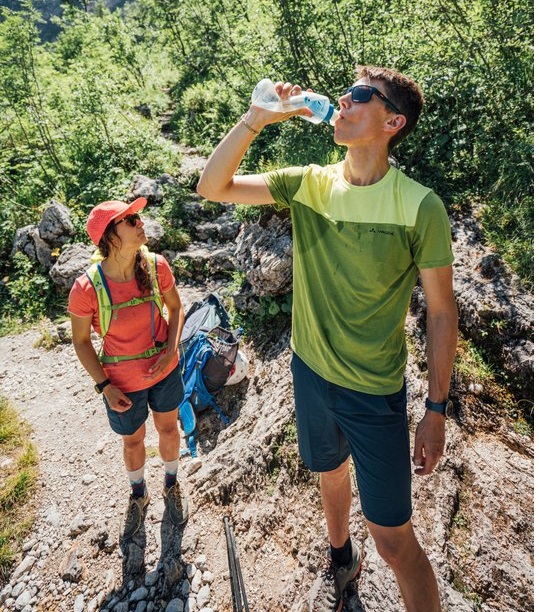
- Early start: Start early in the morning to avoid the highest heat of the day.
- Choose routes that run mostly in the shade; for example, through forests or on north-facing slopes. South-facing slopes should be walked on early in the morning.
- Alternatives to summit tours: Gorges or paths along rivers and streams are beautiful and offer an excellent alternative to summit tours on hot days.
- Drink enough: Everyone should have at least 2-3 litres of water per day tour with them; for longer or strenuous tours, the need may be higher. Even if you don’t feel thirsty, you should drink regularly.
- Protect yourself from the sun: Use high-quality sun protection with a high sun protection factor and reapply regularly. Clothing with a high protection factor minimises radiation to the body, headgear and sunglasses protect the head and eyes.
- Pack weather protection: The weather changes quickly in the mountains and what started as a bright day can also end in a storm. That’s why you should always have a rain jacket and a sweater with you. On ridges and shady paths, it can also be cool and windy at altitude. Here, too, the extra layer protects against cooling.
Thunderstorm risk
Storms usually have a higher intensity in the mountains. Here, not only the lightning strike poses a danger but also not cooling down in the storm or slipping because of wet paths. The risk of lightning strikes is particularly high in exposed places such as ridges or peaks – as well as on via ferratas. The most important thing is to always keep an eye on the weather before and during the tour so that you don’t get into a critical situation in the first place.
“Heat thunderstorms often occur on hot days,” says expert Janotte. Then the temperature of the air layers near the ground rises particularly sharply, it expands and rises. This leads to so-called convection flows: The warm air cools down in the higher layers and condenses into cumulus clouds, the typical cluster clouds.
“If they continue to rise from the earth’s surface due to enough ‘replenishment’, they finally reach the tropopause. There, the air cannot rise any further, while warm air flows in from below. The cumulonimbus cloud with its typical anvil shape is formed. Due to the intense air currents in the cloud, electrical charges can be separated, which leads to lightning and thunder – a thunderstorm.”
Tips:
- Check the weather forecast: Inform yourself regularly about the weather development before the tour. Also during the tour, regularly keep an eye on the tendency for thunderstorms in the sky. Muggy in the morning and early cluster clouds are a sign of a high risk of thunderstorms.
- Turn back early: At the first sign of a thunderstorm – dark clouds, rolling thunder – immediately make your way back or seek shelter. As the risk of thunderstorms increases sharply from noon, it is best to plan the tour so that exposed areas are already walked on in the morning.
- Act smart: If you get into a thunderstorm, you should leave exposed places such as peaks, ridges or open spaces as quickly as possible. If this is not possible, sit on your rucksack in a hollow with your legs together and keep your distance from metal objects.
Photos: DAV/Julian Rohn

